GitHub Copilot, Cursor, Claude Code, Windsurf and the rest - what you need to know about cost, security and compliance before your organisation commits.
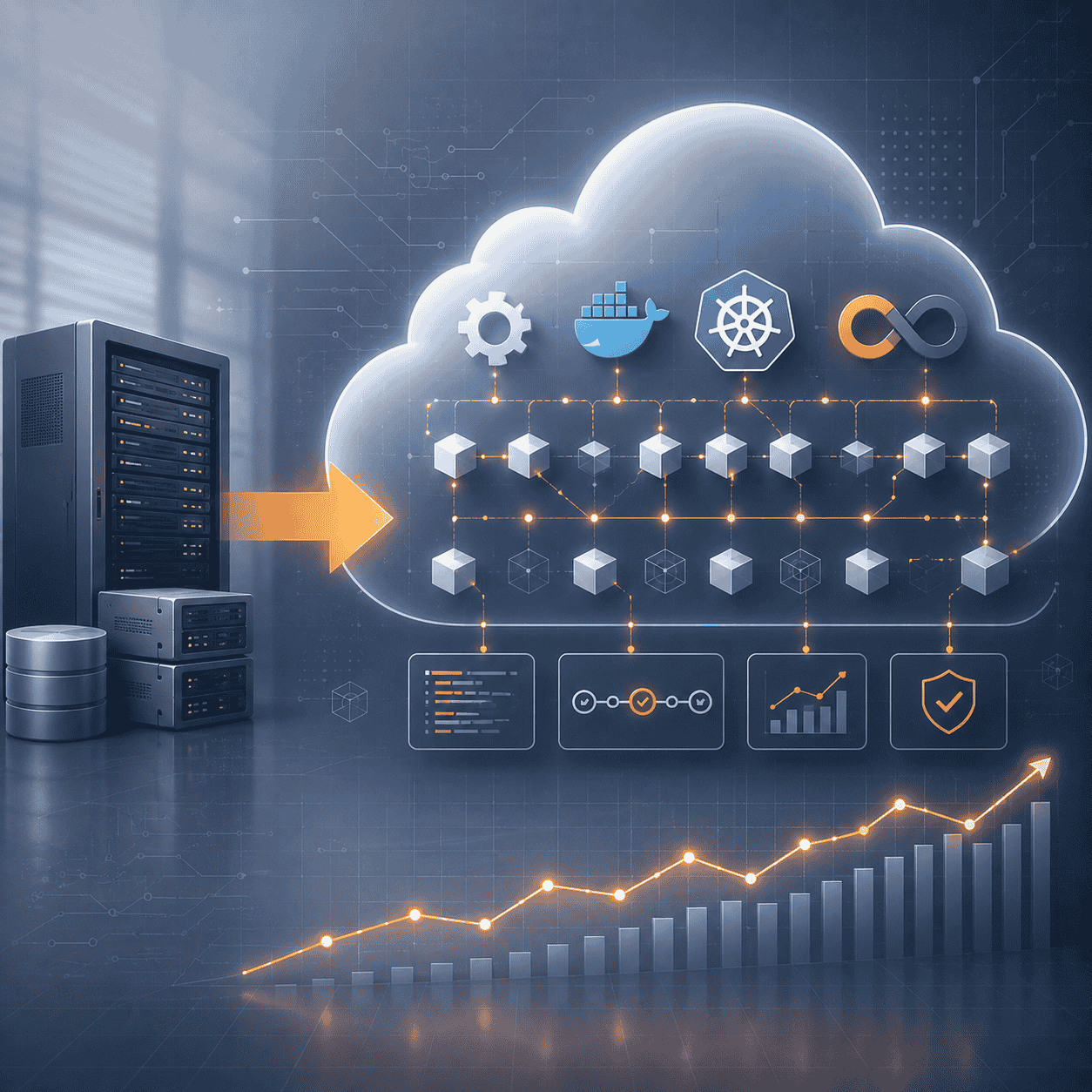
From containerisation to CI/CD pipelines, from legacy migration to cloud-native development. With financial services experience - we understand compliance requirements and the risks of mission-critical systems.

Docker and Kubernetes
CI/CD and IaC
Azure, AWS
.png)


.png)


The promise of cloud migration: flexibility, scalability, lower cost. The reality is often different: existing systems were lifted and shifted, the architecture didn't change, and the cloud bill multiplied. The cloud doesn't optimise anything on its own - architecture determines cost.
Existing monolithic applications - especially older Java, .NET or COBOL systems - can't simply be moved to the cloud. Rewriting is expensive, and 'just moving it' doesn't deliver the expected results. The right path: incremental containerisation and a strangler fig migration.
Containerisation and Kubernetes are not a one-off project but a change of operating model. Without the right DevOps capability in the organisation, adoption drags on, the system becomes unstable and the development team loses the agility the cloud promised.
The MNB's (Central Bank of Hungary) Recommendation 2/2025 on cloud services, the DORA regulation, GDPR and data localisation requirements all limit what can be moved to the cloud, and how. A generalist cloud consultant doesn't know this context - and a wrong decision surfaces in an audit.
The promise of cloud migration: flexibility, scalability, lower cost. The reality is often different: existing systems were lifted and shifted, the architecture didn't change, and the cloud bill multiplied. The cloud doesn't optimise anything on its own - architecture determines cost.
Existing monolithic applications - especially older Java, .NET or COBOL systems - can't simply be moved to the cloud. Rewriting is expensive, and 'just moving it' doesn't deliver the expected results. The right path: incremental containerisation and a strangler fig migration.
Containerisation and Kubernetes are not a one-off project but a change of operating model. Without the right DevOps capability in the organisation, adoption drags on, the system becomes unstable and the development team loses the agility the cloud promised.
The MNB's (Central Bank of Hungary) Recommendation 2/2025 on cloud services, the DORA regulation, GDPR and data localisation requirements all limit what can be moved to the cloud, and how. A generalist cloud consultant doesn't know this context - and a wrong decision surfaces in an audit.
The cloud pays off when the architecture changes too. First we assess what is worth moving to the cloud and what isn't, then we containerise incrementally, automate the release process and keep monitoring costs after go-live. Financial services compliance requirements are built in from the very first design step.
Existing systems
Containerising existing applications - including older Java and .NET applications - with Docker and migrating them to the cloud incrementally. Not a big bang but a strangler fig approach: the system keeps running while migration happens step by step. Hands-on experience: containerising a Java 8 insurance application and providing ongoing support.
Design
Designing Azure or AWS cloud architectures that meet financial services requirements - data localisation, central bank recommendations, compliance. Rolling out Kubernetes-based platforms on-premise or in the public cloud, taking the existing system landscape into account.
Automation
Building automated development and deployment pipelines (CI/CD) for faster, more reliable software releases - with an infrastructure as code (IaC) approach and FinOps optimisation to keep cloud costs under control.
In operation
After moving to the cloud, many large enterprises are surprised by a growing bill - resources are easy to spin up, and if nobody watches them actively, costs run away quickly. We provide continuous visibility and cost governance: we identify unused resources, recommend architecture optimisations and introduce FinOps practices - so the cloud is genuinely cheaper, not just a different kind of spend.
Existing systems
Containerising existing applications - including older Java and .NET applications - with Docker and migrating them to the cloud incrementally. Not a big bang but a strangler fig approach: the system keeps running while migration happens step by step. Hands-on experience: containerising a Java 8 insurance application and providing ongoing support.
Designing Azure or AWS cloud architectures that meet financial services requirements - data localisation, central bank recommendations, compliance. Rolling out Kubernetes-based platforms on-premise or in the public cloud, taking the existing system landscape into account.
Design
Automation
Building automated development and deployment pipelines (CI/CD) for faster, more reliable software releases - with an infrastructure as code (IaC) approach and FinOps optimisation to keep cloud costs under control.
After moving to the cloud, many large enterprises are surprised by a growing bill - resources are easy to spin up, and if nobody watches them actively, costs run away quickly. We provide continuous visibility and cost governance: we identify unused resources, recommend architecture optimisations and introduce FinOps practices - so the cloud is genuinely cheaper, not just a different kind of spend.
In operation
Central bank expectations, DORA, GDPR and data localisation rules significantly constrain cloud options in financial services. You don't need to explain them - we know the constraints and design architectures that meet them.
Most cloud consultants prefer to work on new systems. FrontX's strength is containerising and migrating old, complex, undocumented systems. Our Java 8 containerisation work is exactly that - a live project, not theory.
Not every system needs to move to the cloud. Not every application needs Kubernetes. Business goals, existing infrastructure and the risk profile determine the architecture - not the latest technology trend.
Cloud migration is not a one-off project. Running the live system, version upgrades, performance optimisation and cloud cost control are ongoing tasks. We also work under ongoing support models, as a managed service or on an hourly basis.
Central bank expectations, DORA, GDPR and data localisation rules significantly constrain cloud options in financial services. You don't need to explain them - we know the constraints and design architectures that meet them.
Most cloud consultants prefer to work on new systems. FrontX's strength is containerising and migrating old, complex, undocumented systems. Our Java 8 containerisation work is exactly that - a live project, not theory.
Not every system needs to move to the cloud. Not every application needs Kubernetes. Business goals, existing infrastructure and the risk profile determine the architecture - not the latest technology trend.
Cloud migration is not a one-off project. Running the live system, version upgrades, performance optimisation and cloud cost control are ongoing tasks. We also work under ongoing support models, as a managed service or on an hourly basis.
We containerised an insurer's Java 8 business application so it continues to run in a stable, reproducible environment, and we support it under an ongoing support arrangement. The old system didn't have to be rewritten to move to modern, container-based operations.
For an innovative start-up we built a greenfield, containerised back-office registry running on AWS. The Java, Spring Boot and Angular application covers the full process of carbon credit issuance, settlement and administrative record-keeping.
We provided an Azure architect, a solution architect and a systems analyst for an energy company. Cloud architecture, solution design and systems analysis came from a single team.
We containerised an insurer's Java 8 business application so it continues to run in a stable, reproducible environment, and we support it under an ongoing support arrangement. The old system didn't have to be rewritten to move to modern, container-based operations.
For an innovative start-up we built a greenfield, containerised back-office registry running on AWS. The Java, Spring Boot and Angular application covers the full process of carbon credit issuance, settlement and administrative record-keeping.
We provided an Azure architect, a solution architect and a systems analyst for an energy company. Cloud architecture, solution design and systems analysis came from a single team.
No. Business goals, existing infrastructure, the risk profile and regulatory requirements decide what moves to the cloud, what stays on-premise and what runs in a hybrid model. We prepare this decision with an assessment before migration.
With lift-and-shift, the system moves to the cloud with its architecture unchanged - fast, but cost and scalability don't improve. With containerisation, the application is packaged into Docker containers, so it runs in a reproducible environment, scales more easily and can be modernised incrementally.
We take the MNB cloud recommendation, DORA, GDPR and data localisation requirements into account from the architecture design stage - rather than finding out in an audit that a solution doesn't comply.